You’ve finally decided to go skydiving.
Maybe it’s something you’ve wanted to do for years. Maybe you’ve watched those incredible videos of people jumping out of aircraft and thought, “One day, that’s going to be me.”
And now that you’re actually considering it, a few practical questions come to mind.
Am I old enough? Is there a weight limit? Do I need to be extremely fit? What if I have a medical condition?
Perhaps you’re planning a surprise birthday adventure for your parents. Or you’re wondering whether your teenage son or daughter can experience skydiving.
These are questions worth asking before you book.
The good news is that tandem skydiving doesn’t require previous skydiving experience or the fitness level of a professional athlete. But there are eligibility requirements, and understanding them is an important part of preparing for your first jump.
At Skydive India, operated by Macsen Aviation Pvt. Ltd. in Rajasthan, participation depends on age, weight, medical suitability, equipment fit and the ability to follow safety instructions.
Here’s everything you should know before planning your first skydive.
Who Can Go Skydiving in India?
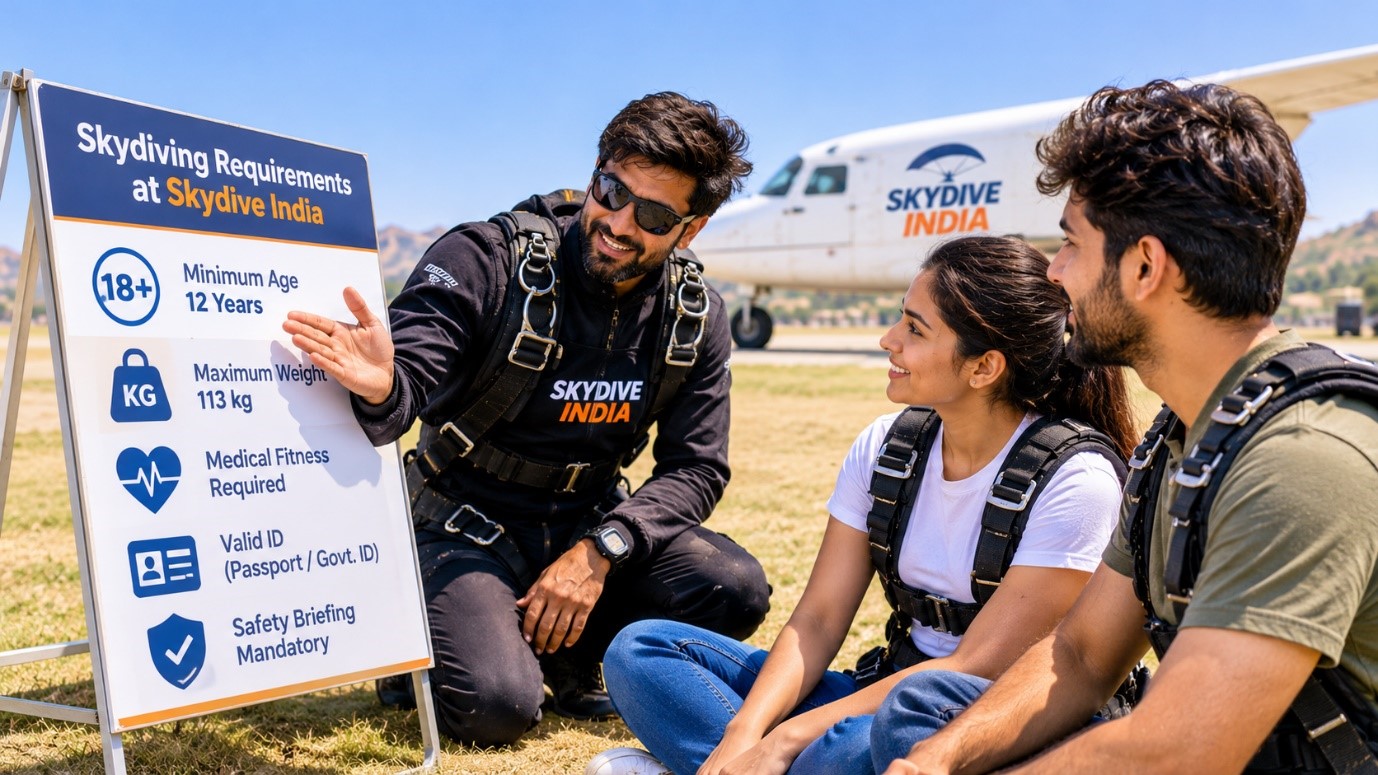
The short answer: At Skydive India, the published minimum participation age is 12 years, with parental or guardian consent required for participants under 18. The advertised maximum weight is 113 kg. Participants must also meet the applicable medical, physical and documentation requirements and receive approval from the instructor and operations team.
Requirements can differ between skydiving operators and training programmes. These numbers describe Skydive India’s currently published conditions, not a universal rule for every location in India.
Here’s a quick overview.
| Requirement | Skydive India’s Published Conditions |
| Minimum age | 12 years |
| Participants aged 12–17 | Valid parental or guardian consent required |
| Participants aged 18 and above | Subject to normal eligibility checks |
| Maximum advertised weight | 113 kg |
| Previous skydiving experience | Not required for tandem skydiving |
| Medical fitness | Required; medical certificates may be requested |
| Identification | Valid government-issued ID or passport |
| Safety briefing | Mandatory before participating |
| Final approval | Instructor and operations team |
Before making travel arrangements, confirm the current requirements directly with the team.
Check Tandem Skydiving Details
What Is the Minimum Age for Skydiving in India?
Age is one of the first things people check when planning an adventure activity.
At Skydive India, the currently published minimum age for participation is 12 years.
But there’s an important distinction between being old enough to meet the advertised minimum and being approved to jump.
A younger participant must be able to understand the safety briefing, cooperate with the instructor and meet the equipment and physical suitability requirements.
Can a 12-Year-Old Go Skydiving?
Skydive India’s published conditions allow consideration from age 12, subject to the applicable requirements.
However, a 12-year-old cannot simply arrive and participate without the required guardian permission and operational assessment.
The child’s physical suitability, harness fit, ability to follow instructions and overall readiness must be assessed.
If you’re planning skydiving as a birthday surprise for a child, speak with the team before making payment.
It’s better to confirm eligibility first than to promise an experience that may not be approved.
Can Teenagers Aged 13 to 17 Go Skydiving?
Under Skydive India’s advertised requirements, teenagers aged 13 to 17 may be considered for participation with valid parental or guardian consent.
The same equipment, health and instructor-assessment requirements apply.
Parents should ask the team what consent documents are required and whether a parent or legal guardian needs to be present during check-in.
Can You Go Skydiving at 18?
Yes. At 18, you meet Skydive India’s published minimum age without needing the parental consent required for minors.
However, being 18 doesn’t automatically mean you are eligible.
You still need to meet the relevant weight, fitness, documentation and operational requirements.
Is There an Upper Age Limit for Skydiving?
Imagine a father in his sixties watching his daughter return from a skydive.
She’s excited, talking about the experience, and showing everyone the video.
Then he asks, “Do you think I could do that too?”
It’s a wonderful question.
People sometimes assume that adventure sports are only for those in their twenties or thirties. But age alone doesn’t tell you everything about somebody’s physical ability or medical condition.
Skydive India’s reviewed public eligibility information does not specify a universal maximum age.
That doesn’t mean every older adult will automatically be approved.
An older participant may need additional assessment of general health, mobility, medical history and ability to comply with the required landing posture.
If you’re considering skydiving for yourself, a parent or a grandparent, contact the team with the relevant details before booking.
The question isn’t simply how old you are. It’s whether you meet the requirements for the activity.
What Is the Weight Limit for Skydiving in India?
Another common question is:
“I’m slightly overweight. Can I still go skydiving?”
The answer depends on the operator’s equipment and requirements.
At Skydive India, the maximum advertised participant weight is 113 kg.
The website also lists additional charges for participants in certain weight categories.
| Participant Weight | Advertised Additional Charge |
| Below 95 kg | No weight-related surcharge listed |
| 95–104 kg | ₹3,000 |
| 105–113 kg | ₹6,000 |
| Above 113 kg | Exceeds the advertised maximum |
These are the currently published weight-related charges. They are separate from the tandem package price, and the team should confirm the final payable amount.
Why Does Skydiving Have a Weight Limit?
It isn’t simply about how much weight a parachute can carry.
During a tandem jump, the instructor and participant use a specialised parachute and harness system.
The combined weight, equipment limits, harness fit, balance and landing requirements all need to be considered.
The instructor must be able to manage the jump within the approved operating limits.
For that reason, two people with exactly the same weight may still require different assessments because their height, body proportions, harness fit or physical abilities differ.
Weight limits are part of the equipment and operational assessment, not a judgement about someone’s appearance or fitness.
Can I Go Skydiving If I Weigh 100 kg?
A participant weighing 100 kg falls within Skydive India’s published 95–104 kg bracket, which currently carries an additional ₹3,000 charge.
However, the team must still confirm eligibility based on equipment suitability and the other participation requirements.
Can I Go Skydiving If I Weigh More Than 113 kg?
If your weight exceeds the published 113 kg maximum, don’t make a booking assuming that an exception will be possible.
Speak with the operator before paying.
The limit should not be ignored or treated as something that can be negotiated on the day.
Is There a Minimum Weight or Height Requirement?
The reviewed public information does not give a specific minimum weight or height.
That does not mean there are no equipment-related requirements.
A harness must fit the participant appropriately, and the instructor needs to assess whether the participant can safely take part.
For children, people with smaller body frames or anyone concerned about harness fit, advance confirmation is especially important.
Do You Need to Be Physically Fit for Skydiving?
You don’t need to be a marathon runner or spend hours in the gym to experience a tandem skydive.
But you do need to meet the physical requirements for the activity.
During a tandem jump, the instructor manages the technical operation, while you are expected to cooperate and follow directions.
For example, you will be briefed about positioning your body during the aircraft exit and freefall.
You’ll also receive instructions for preparing for landing.
The ability to understand and carry out these movements matters.
Someone can be physically active and still have a medical condition that needs assessment. Similarly, someone who doesn’t exercise regularly may still be eligible, depending on their health and physical capabilities.
If you have concerns about joint movement, balance, mobility or a previous injury, tell the team before booking.
What Medical Conditions Can Affect Skydiving Eligibility?
This is one area where being completely honest is especially important.
Imagine travelling several hours to the drop zone, arriving excited for your first jump, and only then mentioning that you’ve recently undergone surgery.
The operations team may need to postpone or decline the jump because your medical suitability has not been established.
That conversation is much better to have before making the journey.
Skydive India’s published terms specifically identify several circumstances that should be disclosed.
Heart Conditions and Blood Pressure Concerns
Skydiving involves excitement, aircraft flight, altitude changes and physical demands.
If you have a diagnosed heart condition, significant blood pressure problems, a history of cardiovascular symptoms or relevant medication concerns, seek advice from your treating doctor and discuss the situation with the operator.
Don’t assume that a condition is irrelevant simply because you feel well on the day.
Epilepsy, Seizures or Fainting
A history of seizures, fainting or a neurological condition requires particular attention.
Such conditions may affect your ability to remain aware and follow instructions during the activity.
Disclose the condition before booking and ask what medical documentation or specialist assessment the team requires.
Back, Neck and Joint Problems
A tandem skydive involves aircraft exit, freefall, parachute opening and landing.
These stages can place physical demands on the body.
Previous spinal injuries, major joint problems, recent fractures or restricted movement may require additional assessment.
Even if an injury happened years ago, it may still be relevant to the activity.
Recent Surgery or Serious Injury
If you’ve recently undergone surgery or are recovering from an injury, discuss skydiving with your treating doctor before planning a jump.
Being able to walk comfortably or resume normal daily activities doesn’t automatically mean you’re ready for an aviation adventure activity.
Pregnancy
Pregnancy is specifically listed among the conditions that must be disclosed under Skydive India’s published medical requirements.
If you are pregnant or think you may be pregnant, seek appropriate medical advice and obtain the operator’s decision before considering participation.
Diabetes, Asthma and Other Ongoing Conditions
Not every medical condition is listed individually on an operator’s website.
If you have diabetes, asthma, another respiratory condition, a medical implant, a disability or any ongoing condition that could affect your participation, tell the team in advance.
The relevant questions depend on your individual circumstances.
Never stop taking prescribed medication or conceal a medical condition in an attempt to qualify for a jump.
Medical advice should come from a qualified healthcare professional, and final participation approval remains with the responsible skydiving team.
Is a Medical Fitness Certificate Required for Skydiving?
At Skydive India, a general medical fitness certificate may be required.
Participants with significant medical conditions may also be asked to provide a special medical fitness certificate.
The required format and supporting information should be confirmed directly with the team.
It’s important to distinguish between two things:
A doctor can assess your medical fitness and provide relevant advice or documentation.
The skydiving operator must then determine whether you meet its participation, equipment and operational requirements.
A medical certificate is not an automatic guarantee of jump approval.
If you’re uncertain whether your medical history requires a certificate, ask before travelling. Don’t assume that the absence of a known medical problem means no documentation will be requested.
What Documents Are Required for Skydiving in India?
Nobody wants to arrive excited for a skydive and discover that an important document has been left at home.
A few minutes of preparation can help prevent that.
At Skydive India, participants are required to provide accurate personal and booking details, carry valid identification and complete the necessary declarations and waivers.
Documents to Prepare
| Document | What You Need to Know |
| Government-issued photo ID or passport | Required for identity verification |
| Booking confirmation | Keep your booking reference accessible |
| Participant declaration and liability waiver | Must be completed as required before approval |
| Parental or guardian consent | Required for participants younger than 18 |
| Medical fitness certificate | Bring it if requested by the operator |
| Additional medical documentation | May be requested depending on your medical history |
Skydive India’s preparation guide identifies Aadhaar, PAN card, passport and driving licence as examples of identification. Confirm which document will be accepted for your particular booking.
For visitors from outside India, a passport is a practical document to discuss with the booking team.
If you’re booking for a minor, confirm whether identification for the parent or guardian is also required.
Do not leave the waiver or medical documentation questions until the last minute.
Read Skydive India’s Booking Requirements
Can People With Disabilities Go Skydiving?
A disability does not describe every aspect of a person’s physical abilities.
However, tandem skydiving involves equipment and operational requirements that must be assessed individually.
The team may need to consider harness suitability, aircraft access, communication, body positioning, landing requirements and whether the available equipment and personnel can accommodate the participant.
Skydive India’s reviewed public pages do not establish a general adaptive skydiving programme or promise that every accommodation is available.
If you or someone travelling with you has a disability or mobility limitation, contact the team ahead of time.
Explain your needs clearly and ask whether an appropriate assessment can be arranged.
Don’t assume automatic eligibility or automatic exclusion without that conversation.
Do You Need Previous Experience to Go Skydiving?
No previous skydiving experience is needed for a tandem jump.
That’s one of the reasons tandem skydiving is commonly chosen for a first jump.
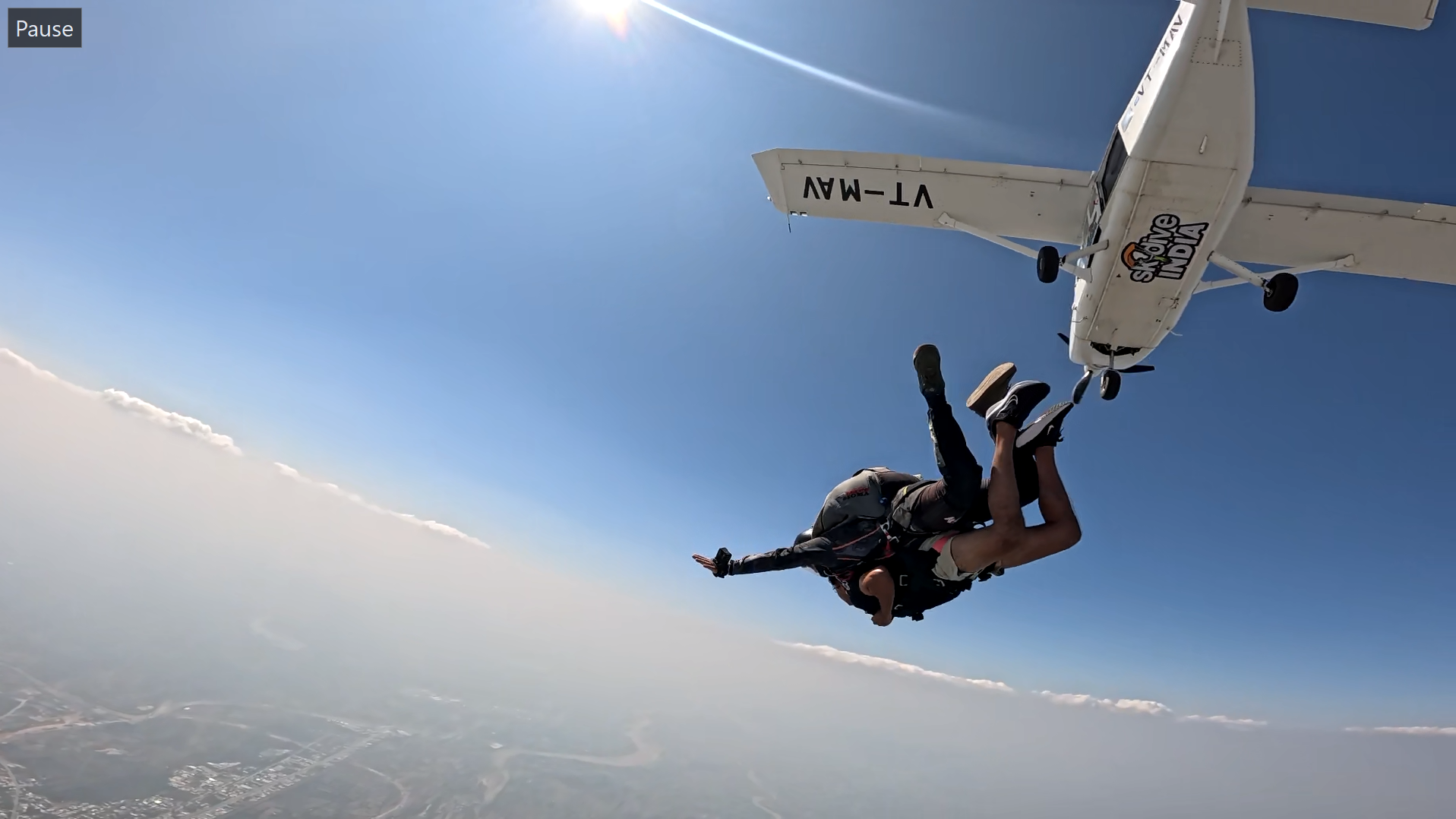
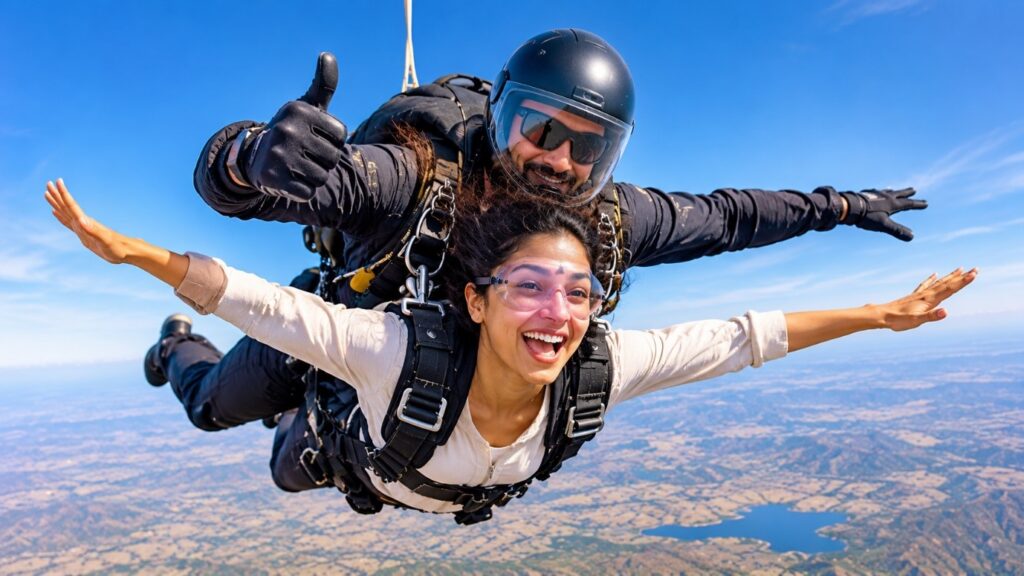
At Skydive India, the tandem experience is advertised from approximately 10,000 feet, with around 30 seconds of freefall under the supervision of a tandem instructor.
Before boarding, you’ll receive a safety briefing about what to expect and how to position your body.
You are not expected to know how to independently operate a parachute.
But you are expected to understand and follow instructions throughout the activity.
If you’re considering learning to skydive independently rather than making a tandem jump, training programmes have separate requirements.
You can explore the Accelerated Freefall programme for more information.
What Should You Avoid Before Skydiving?
Being eligible to jump is one thing.
Arriving prepared for the experience is another.
The goal is to make your visit as comfortable and straightforward as possible.
Avoid Alcohol and Intoxicating Substances
Skydive India’s terms prohibit participation under the influence of alcohol, recreational drugs or other intoxicating substances.
Do not use alcohol or intoxicants before the activity, and don’t use sedating medication to calm nerves without medical guidance. The company reserves the right to conduct an alcohol test, administered by our medical staff, if there is reasonable suspicion that a participant is under the influence of alcohol. If the test result is positive, the participant will be disqualified from the jump, and all payments made will be forfeited without refund.
If you take prescribed medicines, disclose any concerns about their effects rather than changing your treatment yourself.
Wear Comfortable Clothing
Choose comfortable clothing that allows movement .
Closed-toe sports shoes are required under the operator’s published guidance.
Avoid loose scarves, dangling jewellery and accessories that could become unsecured.
- Wear comfortable athletic clothing and secure lace-up sports shoes without hooks or buckles. Dark-colored clothing is recommended because landing areas may be dusty and clothing may become dirty or stained.
- Unsuitable items include clothing with neck drawstrings; oversized hoodies; bulky sweaters, vests or jackets; baggy or excessively loose trousers; high heels or pointed shoes; crop tops; miniskirts; low-cut tops or revealing necklines; and any other clothing assessed as unsuitable for skydiving.
- Traditional Indian clothing is not suitable for skydiving. Turbans are generally unsuitable; Skydive India retains the final decision on whether and how a Customer/Student wearing a turban can be safely accommodated.
Don’t Arrive Without Eating or Drinking
The operator’s guidance recommends a light meal before skydiving.
Eat and hydrate appropriately for your circumstances and any medical advice you have received.
Don’t Hide an Injury or Medical Concern
If you’ve recently been injured, developed an illness or experienced a change in your health after booking, inform the team.
The right decision may be to request further medical advice or reassess eligibility.
Don’t Make Assumptions About the Schedule
Weather, aircraft operations and equipment readiness can affect the jumping schedule.
Keep some flexibility in your travel plans and confirm your reporting instructions before leaving.
For more practical preparation advice, read How to Prepare for Your First Skydive in India.
Where Can You Experience Tandem Skydiving in Rajasthan?
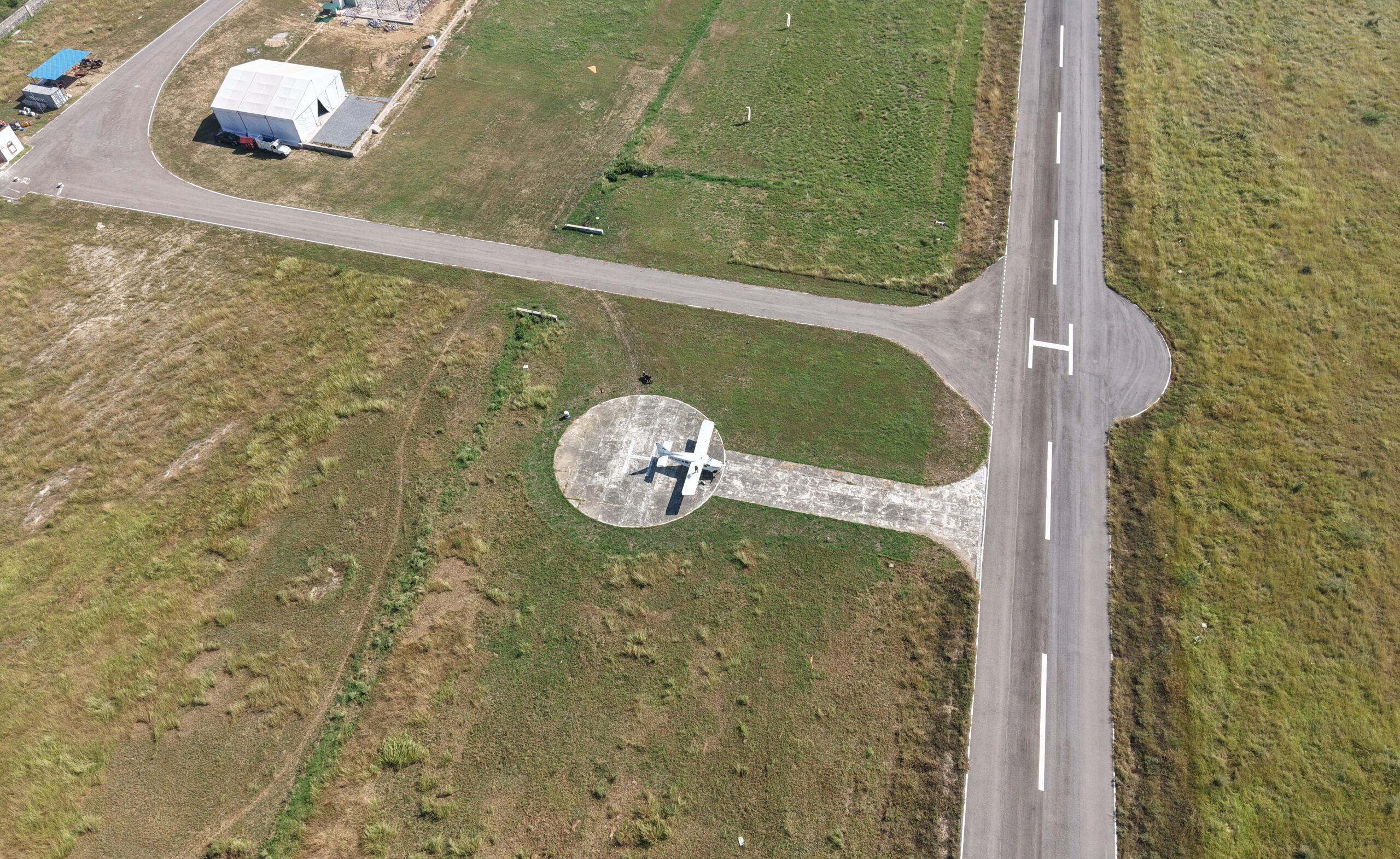
Skydive India operates from Manpur Airstrip near Abu Road, in the Mount Abu region of Rajasthan.
The experience takes place around the Aravalli landscape, offering visitors an opportunity to see this part of Rajasthan from above.
If you’re travelling from Udaipur, Ahmedabad, Jodhpur or another city, confirm the reporting point before arranging transport.
An important distinction: Macsen Aviation’s office is in Udaipur, but the advertised skydiving drop zone is near Abu Road.
Find the Skydiving Location and Travel Information
A Simple Eligibility Checklist Before You Book
Before confirming your first tandem skydive, take a moment to check the essentials.
- Have you confirmed that you meet the minimum age requirement?
- If you’re under 18, have you arranged the required parental or guardian consent?
- Have you disclosed your accurate weight and confirmed any additional charges?
- Have you discussed relevant medical conditions, injuries or medications with the operator?
- Have you obtained any medical certificate requested?
- Do you have valid identification and your booking confirmation?
- Are you able to understand and follow the required safety instructions?
- Have you read the booking, rescheduling and refund conditions?
If you aren’t sure about one of these points, contact the team before paying.
It’s much easier to clarify a question in advance than to deal with an eligibility issue after travelling to the airstrip.
Frequently Asked Questions About Skydiving Eligibility in India
1. What is the minimum age for skydiving in India?
Age requirements can vary by operator and activity. Skydive India currently advertises a minimum age of 12 years and 45 kgs, with parental or guardian consent required for participants under 18. Final approval depends on physical suitability and the operations team’s assessment.
2. Can a 12-year-old go skydiving in India?
At Skydive India, participants aged 12 may be considered for skydiving, subject to valid parental or guardian consent, appropriate equipment fit, 45 kgs, medical suitability and operational approval. Parents should contact the team before booking.
3. Can a 60-year-old go skydiving?
Possibly. Skydive India’s reviewed public eligibility information does not specify a maximum age. Suitability depends on the person’s health, physical abilities, equipment fit and operational assessment. Discuss relevant medical conditions with a qualified doctor and the operator.
4. What is the maximum weight for skydiving in India?
Weight limits differ between operators. Skydive India currently advertises a maximum participant weight of 113 kg for its skydiving experience, subject to instructor and equipment assessment.
5. Can a person weighing 100 kg go skydiving?
A weight of 100 kg is within Skydive India’s advertised weight range. The website currently lists an additional ₹3,000 charge for participants weighing 95–104 kg. Final eligibility must still be confirmed by the team.
6. Can a person weighing 115 kg go skydiving?
A person weighing 115 kg exceeds Skydive India’s currently advertised maximum of 113 kg. They should contact the operator directly rather than making a booking on the assumption that an exception will be available.
7. Is there a minimum height for tandem skydiving?
The reviewed Skydive India public pages do not specify a minimum height. However, harness fit and physical suitability are important. Contact the operator if you’re concerned about height or body size.
8. Is a medical certificate compulsory for skydiving in India?
Requirements depend on the operator and individual circumstances. Skydive India’s terms state that a general medical fitness certificate may be required, while participants with significant medical conditions may need additional certification.
9. Can someone with high blood pressure go skydiving?
This requires an individual medical and operational assessment. Anyone with high blood pressure or a related medical condition should consult their treating doctor and disclose the condition to the operator before booking. Eligibility cannot be determined from a blood pressure diagnosis alone.
10. Can a person with asthma go skydiving?
Asthma requires consideration of the individual’s health, symptoms and treatment. Seek advice from your treating doctor and disclose the condition to the skydiving team. The operator will decide whether the relevant requirements can be met.
11. Can a person with back pain go skydiving?
Back pain, spinal injuries or restricted movement may affect suitability because the activity involves parachute deployment and landing. Obtain appropriate medical advice and discuss the condition with the team before making a booking.
12. Can pregnant women go skydiving?
Pregnancy must be disclosed under Skydive India’s published medical requirements. Anyone who is pregnant or may be pregnant should obtain medical advice and the operator’s decision before considering participation. Do not assume that tandem skydiving is appropriate during pregnancy.
13. What ID proof is required for skydiving?
Skydive India requires valid government-issued identification or a passport. Its preparation guide mentions Aadhaar, PAN card, passport and driving licence. Confirm which documents are accepted for your booking.
14. Do foreigners need special documents to go skydiving in India?
Foreign visitors should confirm identification, waiver and any additional documentation requirements directly with the operator. A valid passport is an important identity document, but requirements may differ according to the participant and activity.
15. Do I need to know how to swim to go skydiving? Its not relevant info
Swimming ability is not listed as a standard requirement on Skydive India’s reviewed tandem eligibility pages. However, you must meet all operator-specific physical, medical and operational requirements. Confirm any concerns directly with the team.
16. Can I go skydiving without previous training?
Yes, tandem skydiving is designed for beginners. You do not need prior skydiving experience, but you must complete the required pre-jump briefing and follow your instructor’s instructions.
17. What happens if I fail an eligibility check on jump day?
Skydive India may refuse or postpone participation if medical, documentation, equipment-fit or operational requirements are not met. Any payment or rescheduling consequences depend on the circumstances and the applicable booking terms. Confirm uncertain requirements before travelling.
Ready to Find Out If Skydiving Is Right for You?
The most important part of planning your first skydive isn’t choosing the perfect video package or deciding what to wear.
It’s knowing whether you’re ready and eligible for the experience.
You might be 18 and planning your first big adventure.
You might be celebrating your 40th birthday.
Or you might be helping a parent or teenager explore something they’ve always wanted to try.
Whatever brings you here, start by asking the right questions.
Check your age and weight requirements. Be open about your medical history. Bring the necessary documents. And speak with the team if you’re unsure about anything.
At Skydive India, operated by Macsen Aviation Pvt. Ltd., you can explore tandem skydiving experiences at Manpur Airstrip near Abu Road, Rajasthan.
Have a question about your eligibility? Ask us before booking.
Check Tandem Skydiving Packages | Contact Our Team | Book Your Skydiving Experience